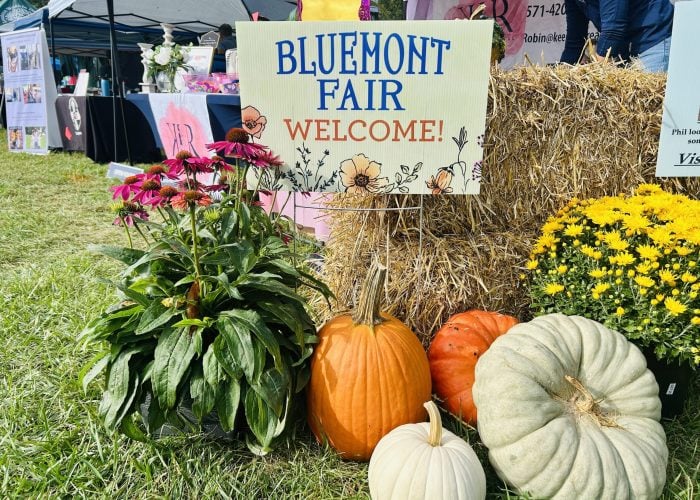
If you've lived in Bluemont for more than a couple of years, you already know the shape of fair weekend. Snickersville Turnpike fills with cars by mid-morning. The Community Center smells like coffee and fresh-baked pie. Somewhere between the petting zoo and the beer garden, you run into three neighbors you haven't seen since last September. That part hasn't changed since 1970, when a handful of volunteers first put together what's now the 56th Annual Bluemont Fair, which was scheduled for Saturday and Sunday, September 19 and 20, from 10 a.m. to 5 p.m.
The 2026 fair was scheduled to feature a theme, a featured local artist, and a new museum layer that weren't part of the fair even two years ago. Those plans marked a change from the familiar routine.
The Fair's Planned Road Closure
The planned traffic pattern for the 2026 fair sent Snickersville Turnpike one-way southbound from Clayton Hall Road through the village to the main parking lot. Drivers approaching from the north end of the turnpike were to use a different route. The exit instructions directed all vehicles to turn left or south back onto the turnpike, then continue either onto the gravel Yellow Schoolhouse Road toward Route 7 or onto Airmont Road for a paved route toward Round Hill and Business Route 7.
The Pickle and Pie Contest, a fixture since the fair's earliest years, required entries at the Community Center by 11 a.m. Anyone dropping off a jar of pickles or a fruit pie needed to reach the village before the one-way pattern and fair crowd settled in.
Judging was scheduled to wrap by early afternoon, with winners to be announced at 1:15 p.m. and the losing entries, which is to say the merely excellent ones, to be sliced and sold to benefit the fair.
This Year's Poster Was Painted by a Neighbor in Round Hill
Every year, the fair's volunteer chairs pick a theme, then open a call for local artists to interpret it for the official poster and merchandise. This year's theme centered on black bears, the animals that turn up along Blue Ridge hiking trails and, often enough, in Western Loudoun backyards. More than twenty artists submitted designs. The chairs chose a painting of a bear wearing a crown of wildflowers with the Blue Ridge Mountains behind it, created by Sara Parella of Round Hill.
Parella moved to Virginia from the Pacific Northwest in 1988 to study at Mary Washington College, where she earned degrees in studio art and political science, and has spent the past three decades working in mental health services around Loudoun County. She also does pottery, rides dressage, and volunteers with local dog and cat rescues. Her artwork now appears on the fair's poster, t-shirts, mugs, and wine glasses, merchandise planned for sale at the E.E. Lake Store and the Gardener's Shed near the Community Center for the 2026 fair.
It's a small detail, but it's the kind that changes every year. The 2026 poster differed from the one from two years ago, and the artist behind it lives one town over.
A New Exhibit Ties the Fair to a Bigger Anniversary
For the second year running, the fair was scheduled to host a juried art show upstairs at the E.E. Lake Store, featuring some of the region's more established painters and craftspeople. That's now a settled tradition. The genuinely new addition for 2026 was a museum exhibition at the Plaster Museum called "The Revolution: An American Mosaic," which highlighted Loudoun County's role in the Revolutionary War. Reenactors from the Sons of the American Revolution were scheduled to give demonstrations alongside it during the country's 250th anniversary year.
The fair's other recurring demonstrations are still there if you know where to look. Archaeologist David Clark sets up in the Montessori Field with artifacts recovered locally, the kind of hands-on table where a kid can hold something dug out of Loudoun soil. Blacksmith Eric Zieg, who also demonstrates at Mount Vernon, works his forge in Stone's Field. Neither is new, but neither shows up anywhere else in the county on a random September weekend, which is part of what makes the fair worth treating as a destination rather than background noise.
Three Stages Were Scheduled to Run at Once, and Where the Day Spilled Over
The fair's live music was scheduled across three stages simultaneously, with Americana, roots, bluegrass, folk, and line dancing. That meant the fair had no single center of gravity. Fairgoers could choose a stage based on what was playing when they arrived, rather than follow one main event everyone funneled toward.
The same was true of where fairgoers could continue their day after the gates closed at 5. Dirt Farm Brewing, the family-run farm brewery about a mile outside the village on Foggy Bottom Road, sits on land the Zurschmeide family has farmed for decades, and its patio looks out over the same Blue Ridge foothills the fair poster depicts. Bluemont Station Brewery and Winery, closer to the village center, has become a regular stop for the same crowd looking for a smash burger or a flatbread after a day of fair food. Neither is part of the official fair footprint, but both are nearby stops for food and drink after a day at the fair.
What Stays the Same
For all the year-to-year changes in theme and programming, the bones of the fair haven't moved since 1970. It's still entirely volunteer-run. Admission is still $10 at the gate, cash or credit, with kids nine and under free and parking free as well. Pets still aren't allowed, a policy the fair has held to after past issues with dog fights and understandably nervous guests. The petting zoo still runs on donated goodwill, with past guests including a camel and, memorably, a wallaby.
A quick list of the 2026 fair's schedule:
- Gates were scheduled to open at 10 a.m. and close at 5 p.m. both Saturday and Sunday
- Snickersville Turnpike was scheduled to run one-way southbound through the village during fair hours
- Pickle and Pie entries were due at the Community Center by 11 a.m. Saturday, with winners scheduled to be announced at 1:15 p.m.
- Three music stages were scheduled to run concurrently, so there was no single main stage to plan around
- Pets were not allowed, rain or shine, and some of the terrain was rough for wheelchairs
None of that was new. The new layer for 2026 was a bear-themed poster from an artist in Round Hill, a Revolutionary War exhibit tied to the country's 250th, and a second year of curated art upstairs at the E.E. Lake Store. That was the part worth paying attention to, because it quietly made the 2026 fair a little different from the one before it, even in a village that's been running this same weekend for 56 years.
If you're new enough to Bluemont that this is your first fair, or curious about what else is happening around the village this fall, Diana Geremia lives and works in Western Loudoun and is always glad to talk about the area, fair season or otherwise. Let's Connect.